
The educational technology landscape changes faster than the views from the express train to Manhattan—within 30 years we’ve seen CD-ROMs and computer labs catapult into generative AI. This year, the TELL Awards, which honor innovative educators who create systemic change through technology, chose to pause and assess the present.
“Today we honor not what is next, but what is best,” said Mary Lynn Collins-Callanan, manager of instructional technology at the Lower Hudson Regional Information Center (LHRIC) in her welcome to honorees and their guests.
Keynote speaker Dr. John Spencer wove reflections on his childhood throughout his address, highlighting the teaching and learning practices that have a lasting impact on students’ lives.
“For years, we were taught a formula,” said Dr. Spencer. “Go to school, get good grades, graduate from a university, and climb the corporate ladder. But with the advent of generative AI, the ladder is gone and our students will instead navigate a complex maze.”
He shared the story of a research project he chose in middle school, on the Negro Leagues and the Integration of Baseball, to illuminate a way to prepare students for the future.
He described how using a typewriter, accessing interlibrary loans, making long distance phone calls and recording on a reel to reel, were slow and frustrating. “And I loved it,” he said, highlighting the power of a productive struggle. “Finding my voice changed my world forever.”
He encouraged his audience to see beyond the ever-evolving technology and cultivate what he called vintage innovations: curiosity, focus, adaptability and empathy. “This is the tool kit that will empower students in the present, and prepare them for the future,” he said. “These are the competencies that will help them navigate the maze.”
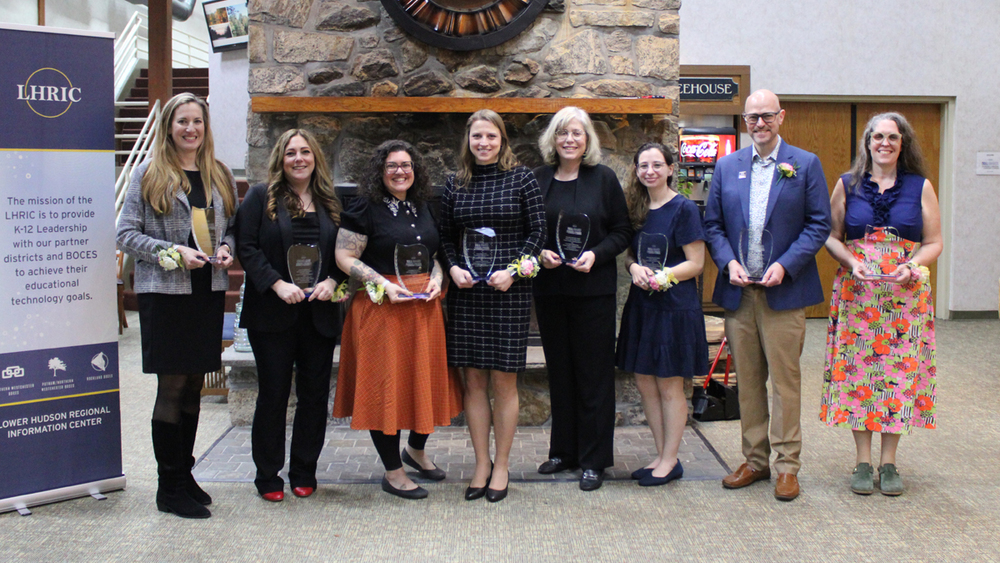
In the awards ceremony that followed, eight honorees echoed and amplified Dr. Spencer’s message.
The first awards category of Innovative Teacher honored three educators.
“Technology will come and go,” said Angela Carrasquillo, media teacher at New Rochelle City Schools, who focuses on storytelling in her media classes. “My work is to help young people discover their voice.”
Paul George, library media specialist and instructional technology specialist at Brewster Central School District, described his library as a maker space in which students design, build, test, redesign and retest to succeed. “I teach students to solve problems,” he said.
An additional Brewster Schools winner, Instructional Technology Specialist Elizabeth (Liz) Hamboussi, spoke about demystifying technology for K-2 learners. She joyfully shared watching children instruct a computer on making a peanut butter and jelly sandwich and seeing them discover that computers do exactly what they are told, no more, no less.
The second awards category of Innovative Instructional Technology Coach honored educators from three districts.
Two instructional technology facilitators from Clarkstown Central School District—Christina Amendola and Katie Kelley—were honored as a team for their shared vision of using technological innovations to transform teaching and learning. They said their work offers them “the best seats in the house,” because they support teachers as well as run programs, including STEAMFest, which tap students’ curiosity and creativity.
“Small things make the biggest impact,” said Nicki Fischetti, a K-12 instructional technology facilitator at Hendrick Hudson Central School District who was honored in the same category. Ms. Fischetti described how participating in collegial circles at PNW BOCES and the LHRIC has been a source of inspiration and growth, and how they inform her work in sharing meaningful use of technology with teachers.
North Rockland Central School District’s Kaitlyn Shields said she uses technology to create things she wanted as a teacher. She described implementing a district-wide communications platform and computer-based testing as exciting ways to support student learning.
The final awards category of Innovative Leader brought the TELL Awards full circle.
Recipient Jennifer Harriton-Wilson, Ed.D., assistant director of educational technology at Putnam-Northern Westchester BOCES, was lauded by Deputy Superintendent Dr. Lynn Allen for her long-standing commitment to leading instructional technology initiatives for district leaders.
Dr. Harriton-Wilson told a story from 20 years ago, in which she and LHRIC Model Schools Coordinator Leslie Accardo stood in front of a SMART board trying to decide if they should write on it with one finger or two.
She called Accardo to the podium and presented her with a companion award, to the delight of all attendees. The moment illustrated what Dr. Spencer highlighted in his keynote: in a connected world, relationships are a vintage innovation that help us through the maze.