‘Open Doors – Open Minds’ provides AI insights for Ed Tech leaders
TLI kickoff looks at social side of AI, the need for intentional conversation
The Technology Leadership Institute launched its yearlong series of events with Dr. Mandy McLean's presentation on “AI as Social Technology.” Artificial intelligence, Dr. McLean says, is reshaping not just how we learn and connect—but who we become.
She traced the technological waves of past generations, from the Internet itself to smartphones and social media, that have shaped what we know and what we value. AI represents a deeper shift, she said, one that touches on identity itself.
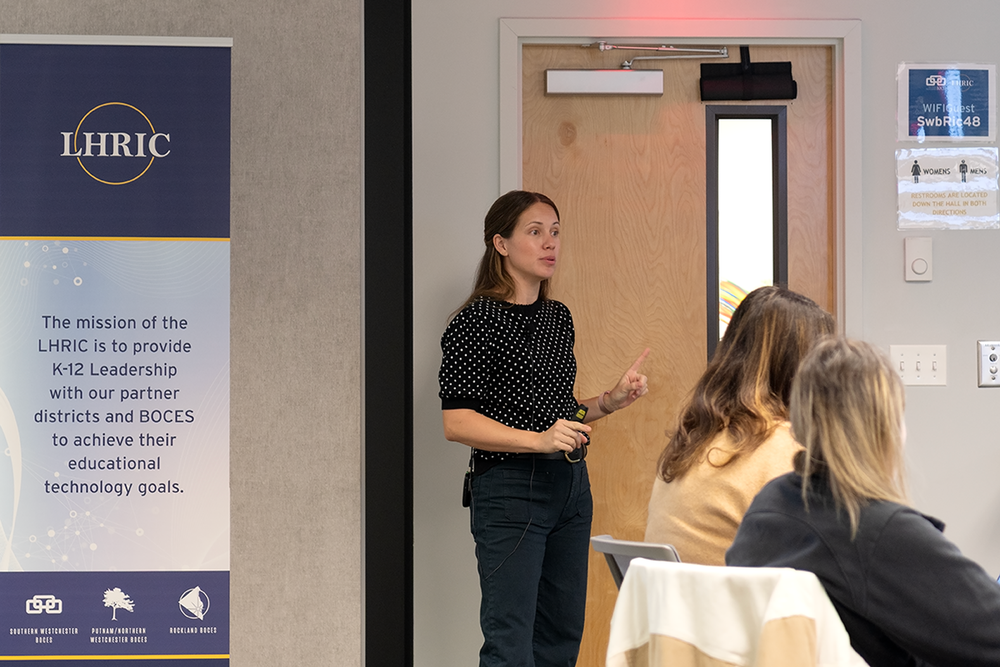
Mandy McLean delivers keynoteGrowing up in rural Newfoundland, Dr. McLean found confidence and community through her math skills—not because of grades or awards, but because of friendships built through shared learning. “Those tiny moments—calls, questions, and connections—made me who I am,” she said. “That identity was born in relationships.”
Today, she warned, those human exchanges risk being replaced by digital efficiency. “If students can ask AI for every answer,” McLean said, “what gets lost in that shift?”
A “power AI user” who believes in the technology’s promise, McLean urged educators to see the bigger picture. Citing a Gallup study, she noted that while AI saves teachers nearly six hours a week, many believe it weakens students’ resilience, critical thinking, and capacity for meaningful relationships.
Her most powerful examples came from her own experiments with “AI companions,” voice-based chatbots designed to simulate empathy and connection. Even as an expert, McLean found her experience with one such bot named Miles disconcertingly human. “It felt like he actually cared about what I had to say,” she said.
Dr. McLean cautioned that these technologies are designed to capture attention and monetize attachment, especially among young users still forming their identities. “AI companions make relationships feel real without the work real relationships require,” she said.
As TLI members embark on a year of exploration and dialogue, McLean’s call to action was clear: embrace innovation—but guard the humanity that makes learning and leadership meaningful.
Dr. Tara Nattrass helps lead an AI discussion Also on the agenda for the day’s exploration of AI in education was a presentation by Dr. Tara Nattrass, who explored the opportunities and risks of AI in education. Dr. Tara Nattrass is co-author of the AI Literacy Framework in collaboration with Code.org and others.
Dr. Nattrass stressed the importance of having intentional conversations about AI use. She illustrated this with personal examples, such as her son immediately recognizing a deepfake TikTok video of rabbits on a trampoline, which highlights how quickly children can detect misinformation compared to adults who may struggle.
Nattrass framed AI use in three areas: teaching with AI for teacher tasks (e.g., content adaptation, lesson planning, and assessment design), teaching with AI to support learning outcomes, and teaching about AI to build literacy and critical thinking. She cautioned that while AI can make content more accessible, it can also unintentionally limit students’ exposure to challenging content.
She connected classroom practice to industry. Examples include biotech researchers using AI to study hibernating ground squirrels to develop cardiac treatments, and JetBlue using AI in aviation operations. By linking these real-world applications, Nattrass underscored the need for students to understand both AI’s potential and its ethical implications.
She advocates for community-based dialogue to prepare students for a world shaped by AI.
Event attendees were treated to a sneak peek at a product Dr. McLean is developing called classwaves.ai. Feedback from educators on new technology helps to ensure it is developed with them, not just for them. Classwaves.ai is software that works as a listening device to provide classroom teachers with insight into group work discussions. It allows real-time feedback to determine whether each group is staying on track, but it does not store the recordings.
To learn more about and to register for upcoming events, visit lhric.org/tli